Junipers are among the most forgiving evergreens you can plant, which is exactly why they get neglected. A ground-hugging Juniperus horizontalis will shrug off a dry July, and a narrow 'Skyrocket' will stand through a gale without complaint. But forgiving isn't the same as indifferent. Give a juniper heavy clay, a hard haircut into old wood, or a wet winter standing in a saucer, and it will sulk for years before it gives up. The jobs below are mostly small. Timing them well is what keeps the plant looking the way it did in the nursery.
Growth starts moving as the soil warms, from mid-March in the south and a few weeks later further north. This is the busiest stretch of the juniper year, though the work is hardly strenuous.
A juniper in open ground on reasonable soil needs very little. If yours is young, or growing in thin sandy or chalky ground, a scatter of balanced general-purpose fertiliser in late March is plenty. Go easy on nitrogen-rich feeds: they push soft, sappy growth that aphids adore and wind snaps. Mulch in April with a few centimetres of well-rotted compost or bark, keeping it clear of the trunk. Container-grown plants are a different matter — begin a fortnightly liquid feed in April and keep going until mid-July.
Late May to mid-June is the safest window. Junipers carry almost no dormant growth on old wood, so anything cut back to bare brown stems stays bare for good. Trim the outer few centimetres to tidy the shape, following the natural line of the branch rather than forcing a box. If one shoot has run away, cut it back to a side shoot further in — but only where there is green growth left to cut to.
Late spring is when cypress aphid does its damage, particularly on dense hedges and screens. Hold a sheet of white paper under a branch and tap it: dark aphids, sticky honeydew and sooty mould are the giveaway. Brown patches that appear in June usually trace back to feeding in May. Scale insects cluster on stems, often on plants in pots, and juniper rust shows itself as swollen galls with orange, jelly-like horns after wet spring weather. Rust needs an alternate host — hawthorn, rowan or pear — nearby to complete its cycle, so it is worth knowing what grows on the other side of the fence.
Once a juniper has settled in — after two full growing seasons — most plants in the ground need no watering at all. Newly planted ones do, and containers always will.
For a new plant, a slow soak once a week in dry spells beats a daily sprinkle. Aim at the root zone rather than the foliage, and water in the morning if you can, so the needles dry before evening. Pots dry out fast: check the top inch of compost and water when it feels dry, which may mean daily during a heatwave. Raise pots on feet and never leave them sitting in a saucer of water. In very hot spells, move containers into light afternoon shade.
A light trim in late June or July keeps hedges and topiary crisp. Finish by mid-August so any new growth has time to harden before winter. Avoid shearing hard in the middle of a heatwave; stressed plants heal slowly and the cut tips can scorch.
Spider mite thrives in hot, dry conditions. Look for fine webbing between the needles and foliage that has turned pale and speckled. A strong jet of water over the foliage in the morning, repeated over a week or two, often deals with a light infestation. Mealybugs collect under pot rims and in the leaf axils — pick them off by hand or wipe the area with a damp cloth.
September and October are ideal for getting a juniper in, while the soil is still warm and the rain has returned. Choose a sunny spot with free-draining ground. On clay, plant on a shallow mound or fork grit into the planting hole, and set the rootball so the top sits level with the surrounding soil. Water it in well and mulch, but keep the mulch off the stem.
Semi-ripe cuttings taken with a small heel in late August or September root reliably in gritty compost in a cold frame; expect them to be ready for potting on the following year. Clear fallen leaves from around the base of established plants, and check stakes and ties before the gales arrive. Stop feeding at the end of summer — soft growth going into winter is a liability. Resist pruning now, too, because wounds callous over very slowly in cold, wet weather.
Heavy snow splays branches apart, and the damage is often permanent. Knock it off with a broom using upward strokes before it freezes solid. Check that ties are not cutting into bark and that stakes are still firm. Young plants in exposed gardens appreciate a temporary screen of netting on the prevailing wind side.
Waterlogged winter soil is the single biggest killer of junipers in this country. Root rot, usually spread by Phytophthora, shows up as foliage thinning and yellowing from the inside out, often noticed in spring. By the time you see it, there is rarely a cure, so prevention is the whole game: empty saucers, stand pots on feet, and avoid treading on saturated soil around the root zone.
Two habits carry the whole calendar. First, grow junipers in ground that drains; everything else follows from that. Second, prune little and often rather than hard and late — a juniper clipped back into old wood is a bare patch you will look at for a decade.
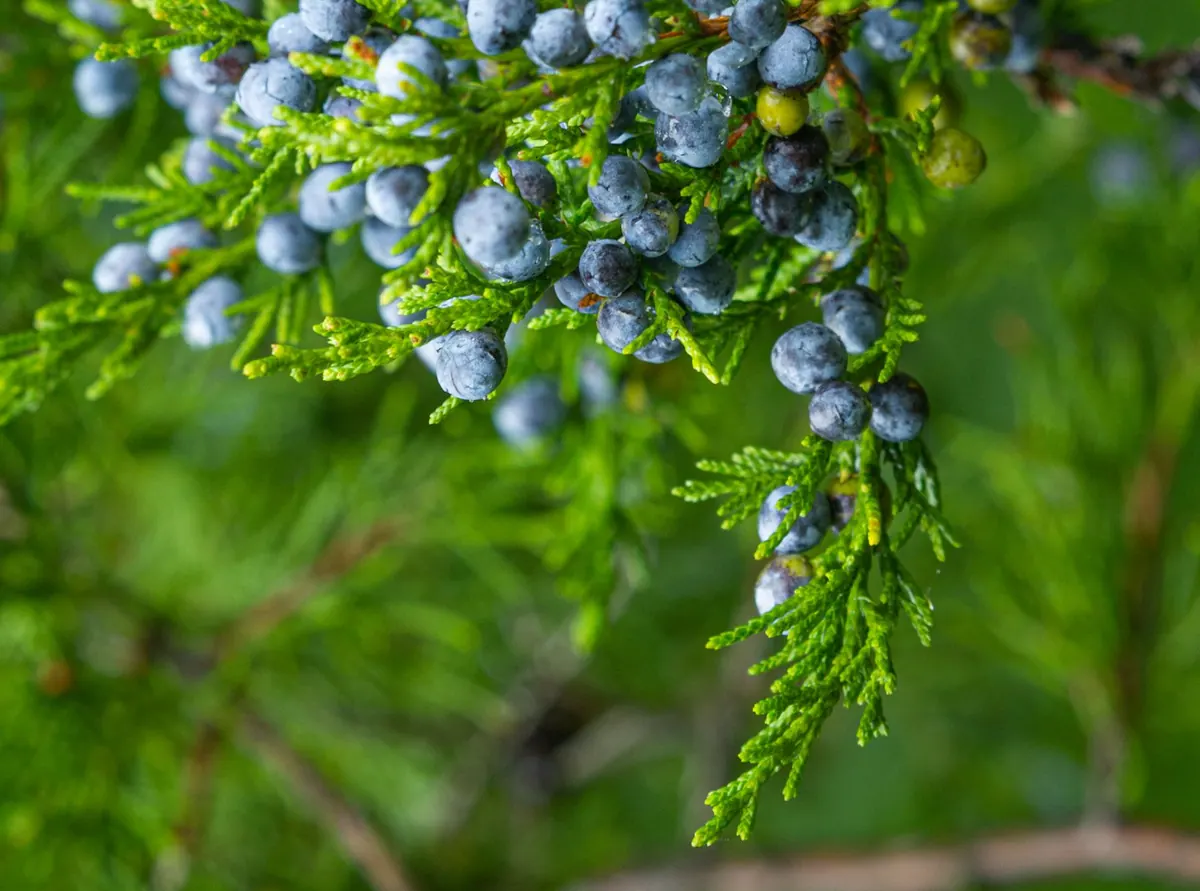
If you have space and limey or heathy soil, the native Juniperus communis is worth considering for the wildlife it supports, though it is slower and fussier about wet feet than the garden varieties. Female plants carry the blue-black cones that ripen over two years and give gin its name. Even if you never harvest a single one, a juniper that gets the right soil, a light trim and a dry winter will
Photo: Garoch / Pixabay